The Operator's Guide to AI in Hospitality
AI is everywhere in hospitality right now, but the gap between the promise and the practical reality is still huge. This guide cuts through the noise with honest insight on where AI actually works for restaurants, pubs, and hotels, what to prioritise, and a phased roadmap for getting started in 2026.
Let's Cut Through the Noise
Every conference panel features someone predicting that AI will "revolutionise" hospitality. And every operator I speak to, whether they run a 40-site restaurant group or a boutique hotel collection, is asking the same question: "What does this actually mean for my business?"
This guide is my attempt to answer that honestly. Not from an academic perspective, but from someone who has spent years sitting between hospitality operators and the technology companies building solutions for them. I have seen what works, what doesn't, and where the genuine opportunities lie for restaurants, pubs, bars, hotels, and everyone in between.
The hospitality market is expected to grow from $5.52 trillion in 2025 to $5.82 trillion in 2026. The industry supports around 371 million employees worldwide. AI adoption is accelerating, with 78% of hotel chains already using AI to some degree and restaurant groups increasingly embedding intelligent tools into their daily operations. But the gap between "using AI" and "getting value from AI" is enormous.
This guide is for operators who want to close that gap.
What AI Actually Means in Hospitality (Without the Buzzwords)
The term "AI" is being applied to everything right now, and it can be confusing. Some of it is genuinely transformative. Some of it is marketing. Here is what the different levels actually mean in a hospitality context, so you can ask better questions when evaluating technology:
Rules-Based Automation
"If X happens, do Y." This powers many of the tools you already use. If a reservation is made, send a confirmation email. If stock drops below a threshold, trigger a reorder alert. It is genuinely useful and saves hours of manual work, but it follows pre-set rules rather than learning from data.
Machine Learning
Systems that learn from your historical data to make predictions. A demand forecasting tool that gets better at predicting covers over time? That is machine learning. A dynamic pricing engine that adjusts hotel rates based on patterns it has identified in booking curves, weather data, and local events? Also machine learning. The more data these systems process, the sharper their predictions become.
Generative AI (Large Language Models)
Systems like ChatGPT that can generate text, answer questions, and hold conversations. In hospitality, these power guest-facing chatbots, review response tools, content creation platforms, and increasingly, the travel planning and restaurant discovery interfaces that consumers are using to decide where to eat and stay.
Agentic AI
The emerging frontier. AI that does not just recommend actions but can take them autonomously. Think of a system that adjusts your staffing schedule, triggers inventory reorders, and modifies menu pricing based on a weather forecast, all working together without manual intervention. This is where the industry is heading in 2026 and beyond, and the technology partners building these capabilities are pushing the boundaries of what is possible.
In 2026, not exploring AI is the equivalent of a restaurant in the early 2000s deciding not to launch a website. The operators who engage now have an opportunity to build a real advantage.
How We Are Helping Operators Get Hands-On with AI
At Stacked, we do not just write about AI. We run hands-on workshops where hospitality teams sit down together and actually use it.
Our AI in Action workshop format puts Claude, Gemini, and ChatGPT through their paces in a live environment. Teams work through real operational challenges specific to their business, from writing SOPs and training materials to building custom tools for menu engineering, allergen management, and front-of-house communication. The goal is simple: by the time you leave the room, you have built something you can actually use back in the business.
We recently ran one of these sessions with the Fulham Shore Group (the team behind Franco Manca and The Real Greek), and the energy in the room was brilliant. Senior operators, marketers, and tech leads all working side by side, testing different AI platforms against each other and discovering which tools genuinely work for their specific use cases.
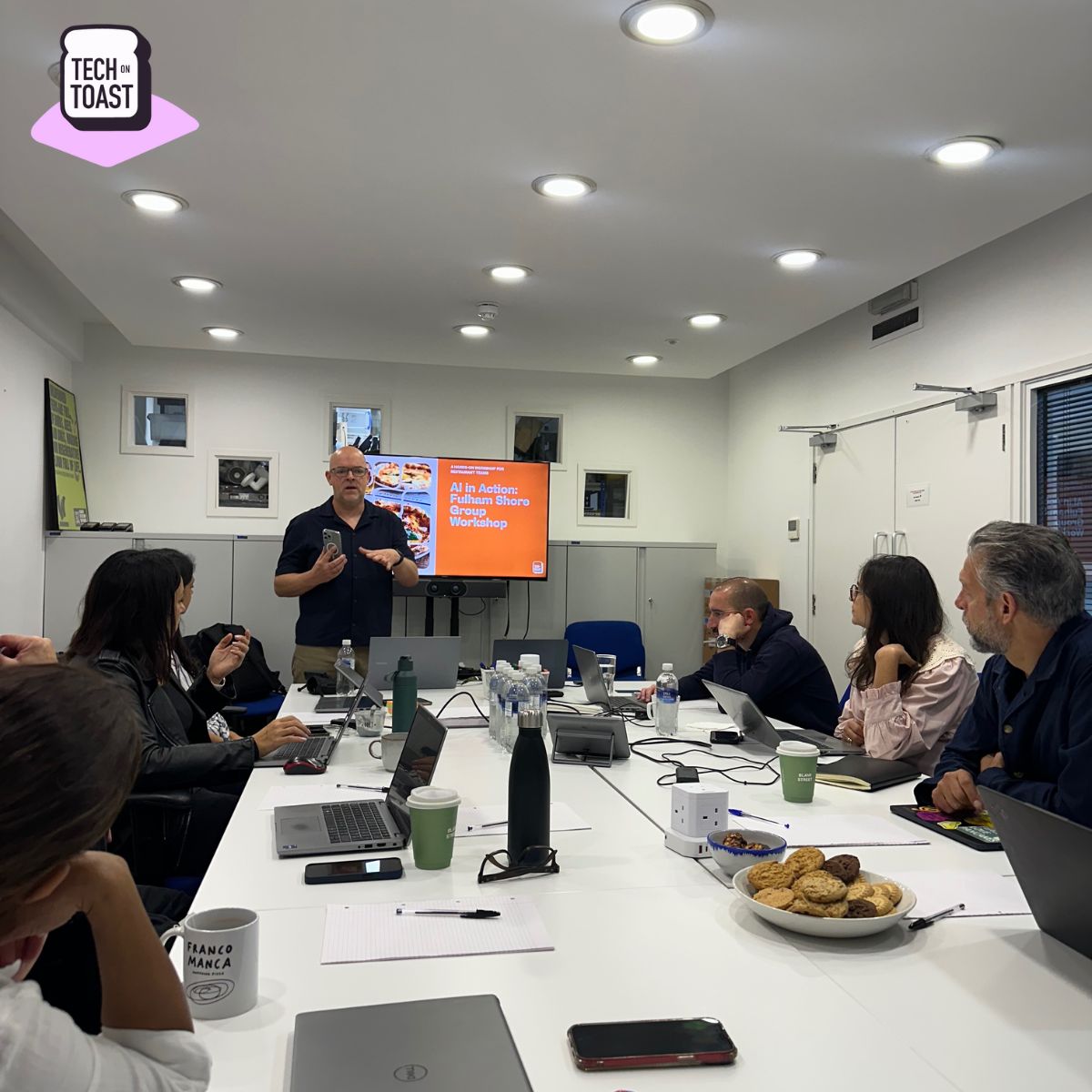
What makes these sessions different from a typical conference talk is that everyone leaves with something tangible. Not a slide deck full of theory, but actual tools, prompts, and workflows they built themselves during the session. We have seen teams build custom allergen checking tools, automated supplier communication templates, and front-of-house quick win generators, all in a single afternoon.
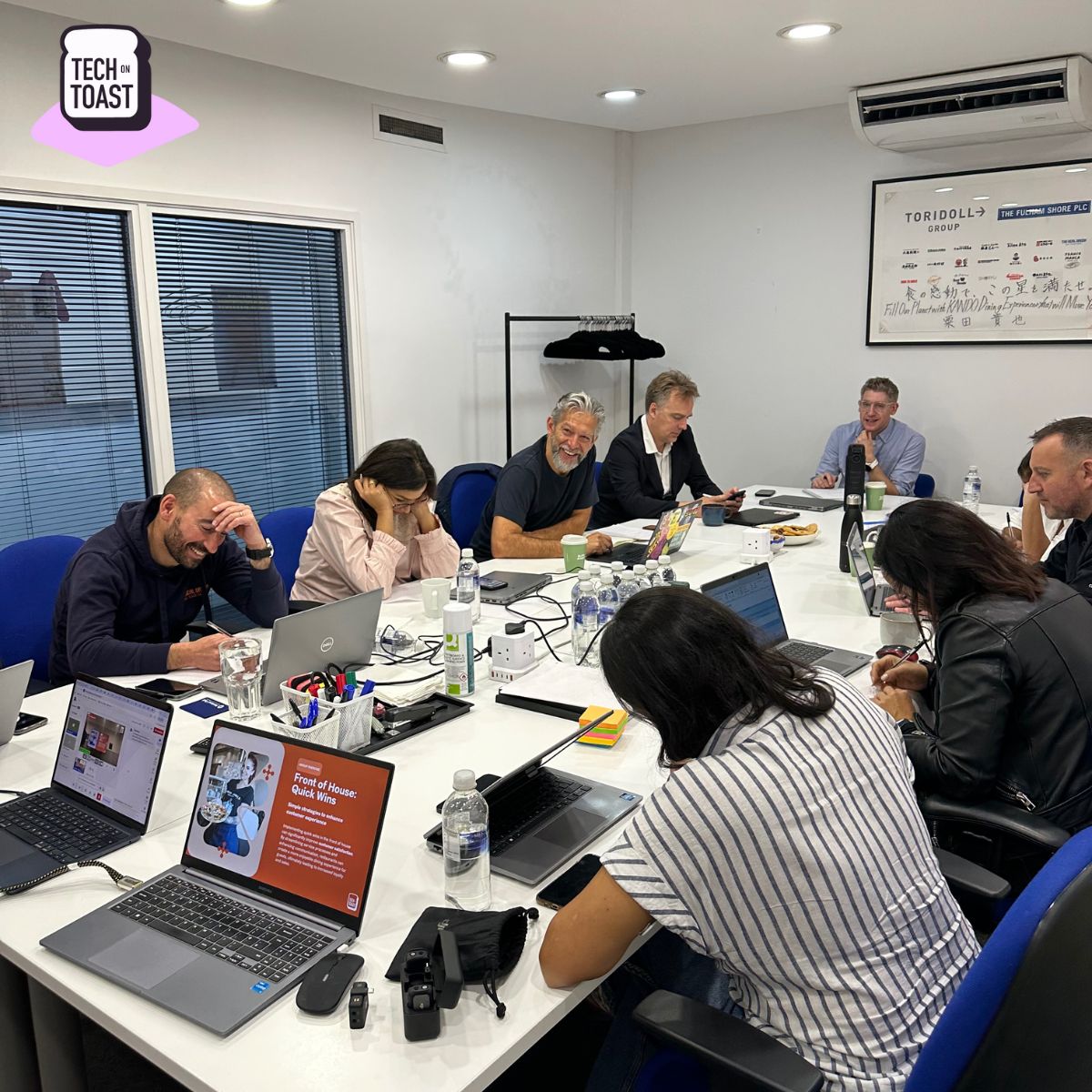
The response has been overwhelming. Teams that walked in sceptical about AI walk out with a completely different perspective, not because we sold them on it, but because they experienced for themselves what these tools can do when applied to problems they actually face every day.
If your team would benefit from a session like this, get in touch. We run these for individual brands, multi-site groups, and as part of our wider events programme.
Where AI is Delivering Real Value Today
Here is where AI is genuinely moving the needle for hospitality operators right now, based on what I am seeing across hundreds of conversations with UK operators and the technology partners on our marketplace.
Workforce Management and Labour Forecasting
For restaurants: Labour is typically 28-35% of revenue. Getting rotas right is the difference between a profitable week and a painful one. AI-driven scheduling tools combine your historical sales data, booking volumes, weather forecasts, and local events to predict how many staff you need, and when, with significantly greater accuracy than gut feel or last week's rota copied forward.
For hotels: The challenge is different but equally pressing. Housekeeping schedules, front desk coverage, and F&B staffing all benefit from demand-led forecasting that adapts to occupancy patterns and group bookings.
Platforms like Sona, S4labour, Nory, Fourth, Bizimply, and Workforce.com are all building AI forecasting into their core products. Each approaches the problem slightly differently, and the right choice depends on your operation's size, complexity, and existing tech stack.
The results are measurable. Operators report reduced overstaffing during quiet periods, better coverage during peaks, and meaningful reductions in labour cost as a percentage of revenue.
Where to start: If you are still building rotas on spreadsheets or gut feel, a WFM platform with AI forecasting should be your first investment. The ROI is typically visible within the first quarter.
Inventory, Waste Reduction and Menu Engineering
For restaurants: This is where AI can have an immediate bottom-line impact. Approximately 38% of food available for consumption goes unsold or uneaten. AI-powered inventory management predicts demand at the dish level, flags variance between theoretical and actual usage, and provides recipe-level cost tracking that updates in real time. For multi-site groups, this visibility across locations is transformative.
For hotels: F&B operations within hotels face the same challenges, often with the added complexity of room service, banqueting, and multiple outlets pulling from shared inventory.
Tools like Nory, Fourth, Apicbase, Supy, growyze, and StockTake Online are making real progress here, helping operators automate ordering, track waste patterns, and engineer menus based on actual margin data rather than guesswork.
Where to start: Connect your POS to your inventory system. Without that data link, AI has nothing to learn from. The intelligence comes from understanding what you sold versus what you ordered.
Guest Communication and Chatbots
For restaurants: Think about how many phone calls go unanswered during a Friday night service. Each one could be a booking, a large party enquiry, or a regular trying to get through. AI-powered reservation assistants and chatbots handle these interactions 24/7 without pulling your team off the floor.
For hotels: Guest messaging platforms handle pre-arrival questions, room service requests, check-out queries, and post-stay follow-ups. Voice AI in particular is crossing a critical threshold, providing immediate, conversational, multilingual response without hold times.
According to a Skift and Oracle report, 77% of guests now prefer automated messaging for quick communication. The technology has matured significantly, and the platforms delivering it are getting better at maintaining the warmth and personality that hospitality demands.
Where to start: Audit how many calls and enquiries your team misses during peak periods. If the number is anything above zero, there is an opportunity worth exploring.
Revenue Management and Dynamic Pricing
For hotels: Revenue management has been the most mature AI use case in hospitality for years. But the sophistication is increasing rapidly. Modern forecasting engines ingest pricing elasticity, booking curves, events, weather, search behaviour, and channel mix data, then continuously learn which signals correlate to outcomes. The gap between best-in-class and average forecasting accuracy is significant, and that gap directly impacts RevPAR.
For restaurants: Dynamic pricing is newer territory, but platforms are emerging that adjust delivery pricing based on demand, optimise promotions across marketplace apps, and use data to inform menu pricing decisions. Expect this to accelerate through 2026.
Marketing and Guest Personalisation
AI-powered CRM and marketing tools like Stampede and me&u are enabling operators to segment guests, personalise offers, and automate communications at a scale that was previously impossible without a dedicated marketing team.
For restaurants: This means targeted offers based on visit frequency, spend patterns, and menu preferences. A regular who always orders the tasting menu gets a different email than someone who visits once a quarter for a quick lunch.
For hotels: Pre-arrival personalisation, loyalty programme optimisation, and post-stay re-engagement campaigns can all be driven by AI analysis of guest data.
According to Access Hospitality's 2025 AI Report, 57% of consumers say technology has significantly improved their hospitality experience. The personalisation piece is where this becomes tangible for the guest.
Businesses waste 286 hours per year switching between unconnected systems. 13% of operational costs are lost due to system fragmentation. Only 1 in 3 operators trust the data they get from their current systems. (Source: Access Hospitality AI Report 2025)
The Biggest Barrier: Disconnected Systems
Here is something that is worth being honest about: AI is only as good as the data it can access.
If your POS does not talk to your scheduling system, which does not talk to your inventory platform, which does not talk to your CRM, then any AI tool will be working with an incomplete picture. The technology partners building these solutions know this, which is why integration capability and open APIs have become such a priority across the sector.
The good news is that the hospitality tech landscape has matured enormously. Most modern platforms are built with integration in mind, and middleware tools make it easier than ever to connect systems that were not originally designed to work together. The vendors on our marketplace are increasingly evaluated on how well they play with others, not just what they do in isolation.
Before investing in any AI tool, ask: does my current tech stack share data effectively? If there are gaps, talk to your existing providers about integration options. You might be surprised how much connectivity is already available.
AI and Discovery: How Guests Find You is Changing
This is the trend that most operators are not yet paying attention to, and it may be the most consequential.
For restaurants: Nearly 40% of US travellers used generative AI tools to plan trips in 2025, and that includes deciding where to eat. When someone asks ChatGPT "best restaurants near me for a business dinner," the answer does not come from your Instagram feed. It comes from structured data: your Google Business Profile, your website schema, your reviews, your menu information.
For hotels: A Booking.com report stated that 89% of respondents want to use AI in future travel planning. AI systems parse structured data at scale, and hotels with clean, schema-marked, data-rich online presences are the ones getting recommended.
This shift does not mean traditional marketing stops working. It means there is a new channel emerging alongside it, and operators who optimise for both human and AI discovery will have an advantage.
Where to start: Make sure your website has proper schema markup, accurate structured data (opening hours, menus, pricing, amenities), and that your Google Business Profile is complete and current. These are the signals AI systems use to decide whether to recommend you.
A Practical AI Roadmap for Operators
Based on hundreds of conversations with hospitality operators across the UK and Ireland, here is the sequence that works, whether you run restaurants, hotels, pubs, or a mix:
Phase 1: Get Your Data House in Order (Month 1-3)
- Audit your current tech stack. Map which systems talk to each other and where data gaps exist.
- Ensure your POS is connected to your scheduling, inventory, and booking systems.
- Clean up your online presence: accurate Google Business Profile, structured website data, current menus.
- Identify your single biggest operational cost pressure. That is where AI will deliver ROI fastest.
Phase 2: Pick One High-Impact Use Case (Month 3-6)
- For restaurant groups, this will typically be workforce scheduling with AI-driven demand forecasting.
- For food-led businesses with high waste, AI-powered inventory management may come first.
- For hotels, dynamic pricing and revenue management is likely the highest-ROI starting point.
- Do not try to do everything at once. Pick one, measure the impact, then expand.
Phase 3: Expand and Connect (Month 6-12)
- Layer in a second AI use case that connects to the first (e.g., scheduling plus inventory for labour-to-sales optimisation).
- Deploy guest-facing AI (chatbot, review management, personalised marketing).
- Train your team. AI literacy is becoming a critical skill. Your managers need to understand what the tools are recommending and why.
- Start tracking AI-specific KPIs: forecast accuracy, labour cost %, waste %, direct booking conversion.
Phase 4: Move Toward Autonomous Operations (Year 2+)
- Explore agentic AI that takes action, not just makes recommendations.
- Optimise for AI discovery (LLM optimisation alongside traditional SEO).
- Consider voice AI for reservations and guest enquiries.
- Build a data culture where decisions are informed by real-time insights, not gut feel.
The Bottom Line
AI in hospitality is not a future trend. It is a present reality. The question is not whether to engage with it, but how quickly and how intelligently.
The operators who will thrive are the ones who treat AI as a tool for making better decisions, not a magic solution that replaces the need for decisions altogether. The best AI in the world cannot fix a broken operation. But applied to a well-run restaurant, pub, or hotel with clean data and connected systems, it can be the difference between surviving and scaling.
The technology partners building these tools are doing genuinely impressive work. The landscape has never been richer or more capable. The challenge for operators is not a lack of options; it is knowing where to start and which solutions fit their specific operation.
Start small. Start with data. Start with one problem you need to solve. And if you need help figuring out where to begin, whether that is a workshop for your team, a technology consultation, or just a conversation, that is exactly what Stacked is here for.